 Lovegobuy
 Four doors into a Chinese listing, and the one you are standing in front of
A link, a name, a photo, or a request form. Which one works is decided by what you already have, not by how good your search technique is.
Two of the four doors are exact and two are approximate. Walking through an approximate one while holding something exact is the most common way to lose an evening.
The link door, which is the only fully exact one
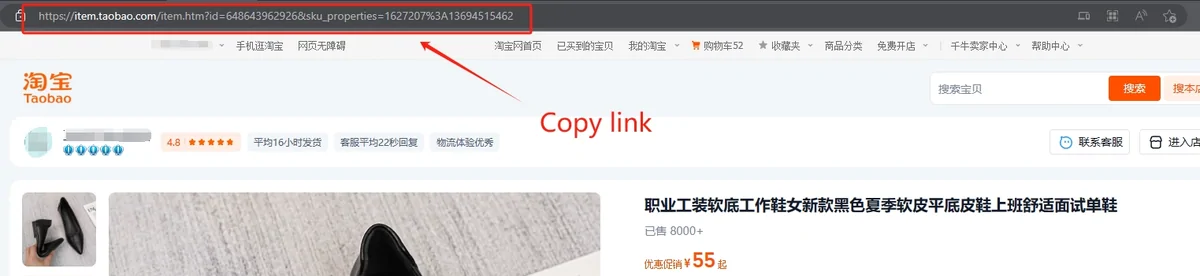
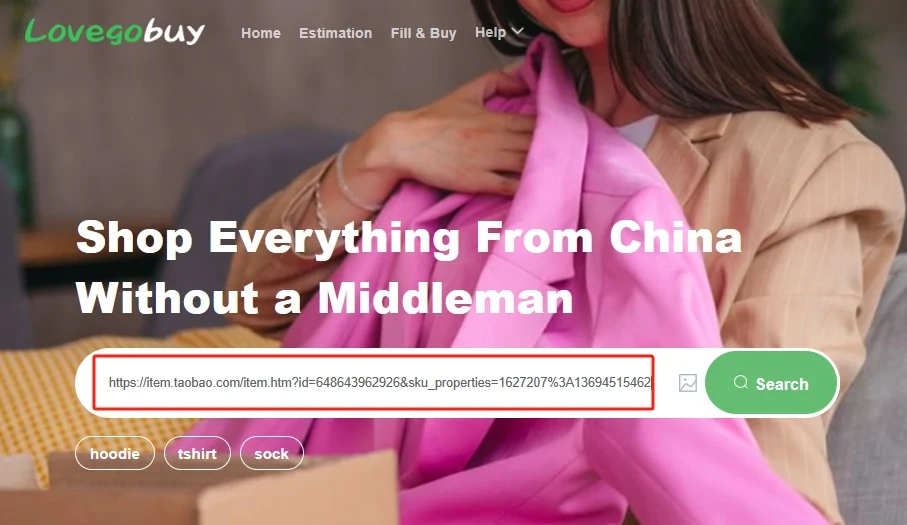
A product address identifies one listing in one shop. Nothing else you can type has that property. If you have the address, the search is already finished: paste it and the page that opens is the page you meant.
The addresses the search box reads directly come from Taobao, Tmall, 1688 and Weidian. The operator's own page title names three of those four outright. Everything else needs the fourth door, further down.
Copy the whole address, including everything after the question mark. Those parameters often carry the shop and the variant. Trimming them is how a link quietly becomes a different listing.
The photo door, approximate on purpose
The home page calls this Smart Image Search and describes it as uploading a picture to find matching items. Captured 2026-10-10. It matches on what the thing looks like, so it is strongest where words are weakest: a print, a silhouette, a buckle.
It is weakest on plain items. A photo of a black crew-neck returns every black crew-neck, which is a result rather than an answer.
The useful way to think about it: the photograph searches for the thing that is unusual about the picture. If nothing in the picture is unusual, there is nothing for it to hold on to.
Use the photo first and words second. The picture gets you to the right shape; a short phrase then cuts that down to the fabric and the fit you actually wanted.

The request form, for platforms the box cannot read
JD, Yupoo, Xianyu, Xiaohongshu and Dewu go through a form rather than the search field. Yupoo in particular is an album host, so there is no product page for any search box to read in the first place.
You submit the address and say what you want from it, and a person picks it up. Slower than a search, and the only route those five have.
If a guide tells you to paste a Yupoo album into the search box, it has not tried it. The box reads product pages. An album is a folder of images.
The name door, where your own wording is the variable
This is the only door where what you type changes what comes back, which is why it gets a page of its own. Two rules carry most of it. Words copied from a seller beat words you translated yourself, and a phrase gets narrower with every word you add, never broader.
Copy before you translate
If you have seen the item on any Chinese page, copy its words and paste them unchanged. A seller's phrasing is already in the vocabulary other sellers use.
Build in seller order
Audience, colour, material, cut, then the garment, written with no spaces. That is the order titles are written in, so it is the order that matches them.
Stop at three or four words
Every word has to appear in the title. A long phrase returns a short list that looks like success and is really a miss.
Delete the most specific word first
When the list dries up, the word nearest the garment is doing the damage. Remove that before you touch the colour.
The keyword tool does all four for any of the sixteen shelves and prints a gloss, so you can read what you are about to paste.
When the link you saved no longer opens
Listings are taken down and shops close. A saved address is a pointer rather than a copy, so when it stops resolving it takes your evidence with it. What survives is whatever you saved somewhere else: a screenshot, a thumbnail, an old order.
| What you still have | The door to use | What to expect |
|---|---|---|
| A screenshot of the listing | Photo | Good odds. An image match does not care that the page is gone. |
| The Chinese title, copied earlier | Name, pasted unchanged | Good odds. Titles get reused across shops selling the same goods. |
| Only your own English description | Name, rebuilt | Weak. Build up from the shelf word instead of translating your sentence. |
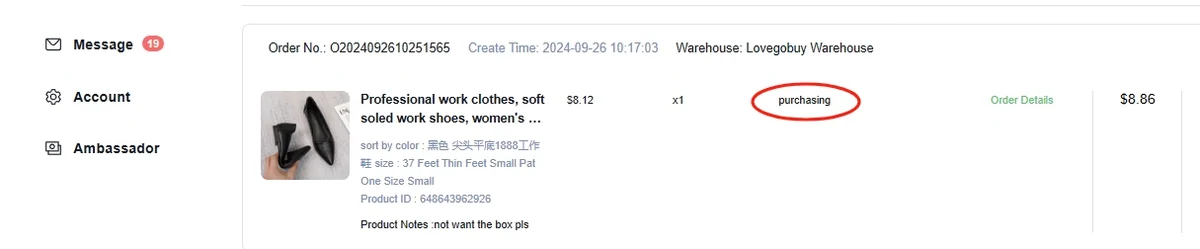
| A previous order of the same thing | The order card | Strongest of all. The card holds both the title and the variant you picked. |
A dead link is not a refund question and not a dispute. It is a search problem that starts from worse evidence than you had yesterday. Which is the whole argument for saving the title rather than the address.
The four doors, side by side
| Door | Exact | Reads | Fails when |
|---|---|---|---|
| Link | Yes | Taobao, Tmall, 1688, Weidian | The listing is taken down, or the address was trimmed. |
| Name | No | Your words, in either language | You translated an English sentence instead of building a phrase. |
| Photo | No | An image file | The item is plain, so every match is equally close. |
| Request form | Yes | JD, Yupoo, Xianyu, Xiaohongshu, Dewu | You expected it to be instant. A person handles it. |
If the door you need is the name door, the keyword tool builds the phrase. If you do not know the word yet, start from a shelf instead.
Keep going
- Build the phrase for the name doorSixteen shelves, seller word order, a gloss and a trap
- Judge the shop you landed onThree scores, and what each one really tracks
- Browse instead of searchingSixteen shelves for when you do not know the word yet
- What the photos can settleSix checks that happen, six that do not